The hard cases require people who can apply a taxonomy consistently, recognize ambiguity, document why a decision was made, and escalate when the rule itself needs improvement. That's closer to specialist operations work than anonymous crowd work.
What the hard cases actually require
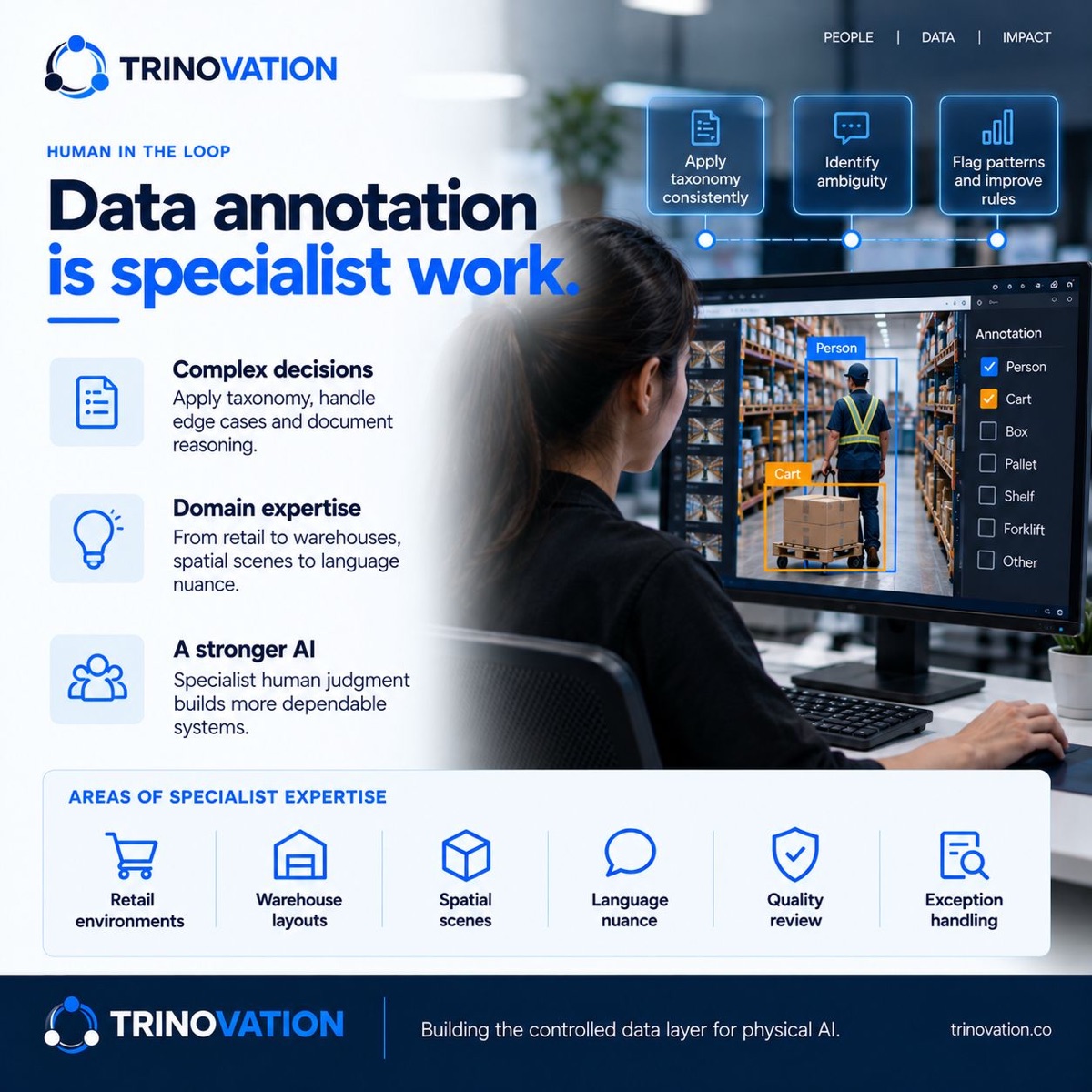
On a real annotation queue, most items are easy. The ones that matter are the ones that aren't — where the taxonomy doesn't quite cover the scene, where two reasonable people would label it differently, or where the rule that made sense last month doesn't hold up against this week's data. Handling those well takes three distinct skills:
- Apply taxonomy consistently
- Identify ambiguity
- Flag patterns and improve rules
That third one is the skill most descriptions of annotation work leave out entirely. A good reviewer doesn't just apply the existing rule — they notice when the rule itself is wrong.
Domain expertise compounds
A strong reviewer develops real expertise in a specific domain, not just familiarity with a labeling tool. That expertise looks different depending on what the model needs to understand:
- Retail environments
- Warehouse layouts
- Spatial scenes
- Language nuance
- Quality review
- Exception handling
A strong team lead sees patterns a dashboard may not: a category creating repeated confusion, a policy that's too vague to apply consistently, or a customer environment that doesn't match the assumptions the taxonomy was built on.
As models improve, specialist human judgment doesn't shrink — it moves upstream. The easy cases get automated first. What's left is the ambiguous, the novel, and the disputed: exactly the work that needs a specialist, not a queue.
Want to see specialist review on your own data?
Send us a sample. We label 500 frames in 5 days and send back an accuracy report — no contract, no call required.
Get a Free 500-Frame Pilot →Treat it as a career path, not a queue
The organizations that treat this work as a career path — with real domain specialization, a path from reviewer to team lead, and a mandate to improve the taxonomy, not just apply it — are the ones that build more dependable AI systems. The ones that treat it as an anonymous queue get anonymous-queue results: consistent on the easy cases, and quietly wrong on the ones that actually mattered.
Building the controlled data layer for physical AI.
Trinovation deploys domain-trained review teams with structured taxonomies, QA workflows and evaluation-ready datasets. First delivery in 2 weeks, no minimum commitment.
Get a Free 500-Frame Pilot → Book a 30-Min Call → Download the Checklist