Building AI's Human Layer Offshore
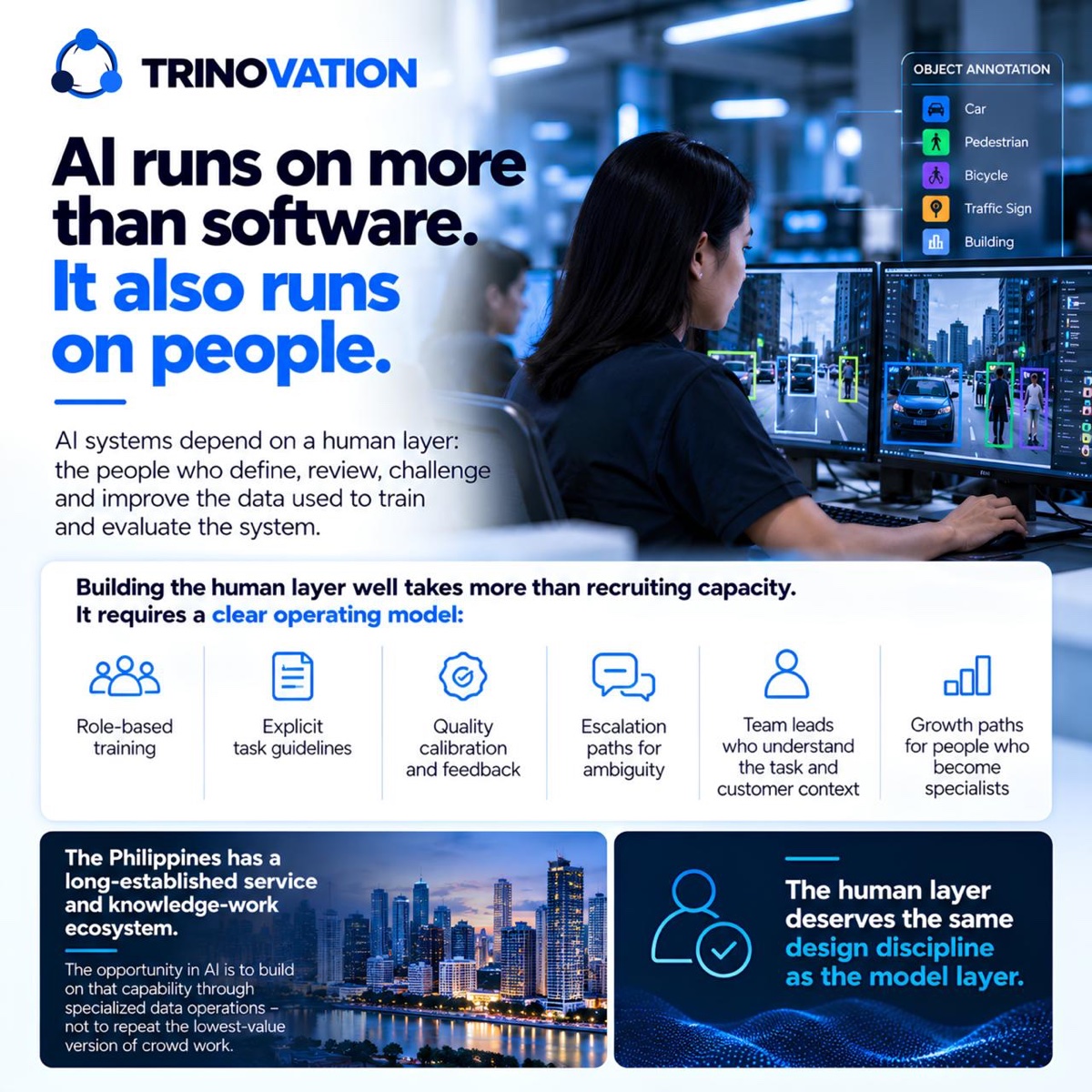
AI runs on more than software. It also runs on people. Why building the human layer takes more than recruiting capacity, and the operating model it needs: training, calibration, escalation, team leads and career paths.
Gold Sets and AI Quality: What an Accuracy Number Really Needs to Mean
95% accuracy sounds reassuring — and tells a buyer almost nothing on its own. The five questions to ask before trusting any quality number, and what a defensible quality claim actually has to include.
Why Edge Cases Become the Product in Production AI
A demonstration proves possibility. Production proves reliability. Why the cases that don’t look like your clean examples decide whether people trust the system.
Sensor Data Is Only the Starting Point
Cameras, RFID readers, equipment monitors and depth sensors each record part of the same event — arriving at different times, under different identifiers, sometimes disagreeing.
What Warehouse AI Actually Needs From Data
A camera, a barcode scan, an inventory system and a robot can each record a different version of the same movement — and none of them is automatically ground truth. What an operating loop for exceptions looks like.
When AI Models Improve, Why Human Judgment Matters More in Production
As models automate the routine examples, what remains isn't less work — it's harder work: edge cases, ambiguity, and decisions with real operating cost. Why human review should be a quality system, not a temporary bridge.
The Real Cost of Bad Training Data (And How to Avoid It)
The annotation invoice is the visible cost — the compute burns, engineering time, and delayed releases downstream dwarf it by 3–5×. Here's where the real costs hide and the five rules that prevent them.
3D Point Cloud Annotation: What It Is, How It Works, and How to Scale It
A practical guide for LiDAR and spatial computing teams — annotation types, the quality benchmarks that matter, and how to scale point cloud labeling without sacrificing accuracy.
What Is Inter-Annotator Agreement (IAA) — and Why Your Model Depends On It
Your model can only be as consistent as the humans who labeled its training data. IAA is the metric that tells you whether your annotation team actually agrees on what they're labeling — and why a low score quietly destroys model performance before you ever see an error rate.
How to Evaluate an AI Annotation Vendor: The 12 Questions We'd Ask
Most AI teams hire annotation vendors after a demo and a pricing call. Here's the framework we'd use to hire right the first time — domain expertise, QA processes, speed, and data security.
Evaluating vendors right now?
Download our free checklist — 12 questions with scoring rubric, green flags, and red flags.
Get a Free 500-Frame Pilot → Get the Free Checklist