Most teams frame this as a cost comparison: a labeling platform license and a few contractors versus a vendor invoice. That framing misses the actual decision, which is about capability ownership — what your team needs to control directly, and what it can responsibly hand to someone else.
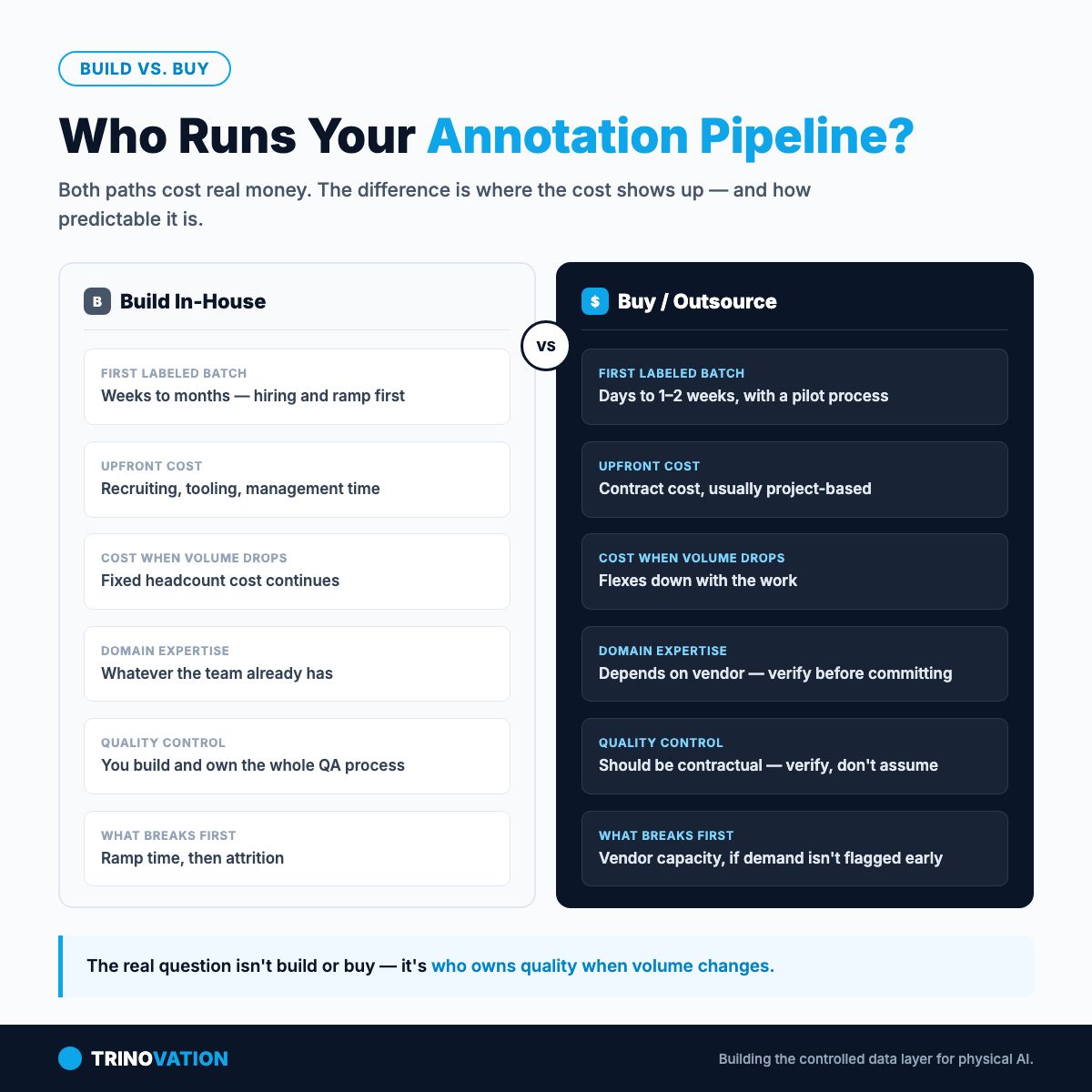
Both paths cost real money. The difference is where the cost shows up and how predictable it is.
What "build" actually includes
An in-house annotation function is rarely just annotators. It typically includes:
- Recruiting and management — sourcing, vetting and supervising a labeling team, or hiring a manager to do it
- Tooling — a labeling platform license, or engineering time to build one
- Taxonomy design — defining classes, edge cases and decision rules before anyone can label consistently
- A QA layer — someone has to measure inter-annotator agreement, review disagreement and maintain a gold set
- Ramp and attrition — every new annotator needs training, and every departure resets part of that investment
None of these show up as a single line item. They show up as a slower first batch, a taxonomy that drifts without anyone noticing, or a quality problem discovered at model evaluation instead of at the labeling stage.
| Build in-house | Buy / outsource | |
|---|---|---|
| Time to first labeled batch | Weeks to months — hiring and ramp first | Days to 1–2 weeks, if a pilot process exists |
| Upfront cost | Recruiting, tooling, management time | Contract cost, usually project-based |
| Cost at steady, high volume | Can be lower per label at true scale | Predictable, but carries a margin |
| Cost when volume drops or pauses | Fixed headcount cost continues | Flexes down with the work |
| Domain / taxonomy expertise | Whatever the team already has | Depends on vendor — verify before committing |
| Quality control | You build and own the QA process | Should be contractual, not assumed |
| What breaks first under pressure | Ramp time, then attrition | Vendor capacity, if demand isn't flagged early |
Neither column is universally better. The right side of the table depends on your volume shape, your timeline and how much of this work is actually core to what you're building.
Why this decision carries more weight than it looks like
Gartner has predicted that through 2026, organizations will abandon 60% of AI projects that are not supported by AI-ready data, and a Q3 2024 Gartner survey found that 63% of data management leaders either lacked the right data practices for AI or were unsure whether they had them.[1] Most of that risk sits upstream of the model — in whether the data pipeline feeding it is disciplined, measured and maintained.
A build-or-buy decision made casually, without accounting for QA and taxonomy ownership, is one of the more common ways that risk enters a project.
When building in-house is the right call
Building makes sense when the annotated data itself is a durable part of your moat — not just an input to one model, but a proprietary asset you'll keep refining for years. It also fits teams with volume that is large, steady and predictable enough to justify permanent headcount, and organizations that already have spare ML-adjacent infrastructure and the management bandwidth to run a QA discipline properly, not as a side responsibility.
If those conditions hold, the fixed cost of an in-house team amortizes well, and you keep full control of the taxonomy as it evolves.
When buying is the right call
Buying tends to fit teams earlier in that curve: volume that is lumpy or still being discovered, a need to see labeled data in days rather than months, a task that requires domain expertise the team doesn't have in-house, and a stage where a permanent ops function isn't yet justified by the roadmap.
McKinsey's State of AI 2026 survey found that 32% of organizations have opted to build rather than buy AI-related software, using agentic coding tools — and that share rises to nearly half among the highest-performing organizations.[2] That trend is real, but it describes software tooling. Annotation is an ongoing human-review discipline, not a one-time build: the taxonomy keeps shifting, edge cases keep appearing, and someone has to keep measuring agreement. That's a different kind of commitment than shipping a tool once.
Not sure which side of the table you're on?
Send us a sample. We label 500 frames in 5 days and send back an accuracy report — no contract, no call required.
Get a Free 500-Frame Pilot →The real question isn't build or buy — it's who owns quality when volume changes
Volume rarely stays flat. A team that builds in-house for a steady 50,000 labels a month can find itself needing 200,000 the next quarter, or dropping to near zero between training runs. The team that owns this decision well is the one that has planned for both directions, not just the current volume.
That's also where a hybrid model often ends up making the most sense: a lean internal team that owns the taxonomy and gold set, paired with flexible outside capacity for the labeling volume itself. You keep the judgment calls in-house and let capacity flex with demand.
The question to ask before signing anything: not "what does this cost per label," but "who is accountable for quality when our volume doubles, and when it drops to zero?" Get a specific answer to that before committing to either path.
Building the controlled data layer for physical AI.
Trinovation deploys domain-trained review teams with structured taxonomies, QA workflows and evaluation-ready datasets. First delivery in 2 weeks, no minimum commitment.
Get a Free 500-Frame Pilot → Book a 30-Min Call → Download the ChecklistSource and review note: [1] Gartner, "Lack of AI-Ready Data Puts AI Projects at Risk" (Feb 2025 press release, citing a Q3 2024 survey of 248 data management leaders). [2] McKinsey & Company, The State of AI: Global Survey 2026. The McKinsey figure describes build-vs-buy decisions for AI software broadly, not annotation services specifically; the distinction drawn in this piece is Trinovation editorial analysis, not a claim from either source.