Production AI depends on people who define, review, challenge and improve the data used for training and evaluation. The technology receives most of the attention, but the quality of the human operating model often determines how quickly difficult cases become reliable learning.
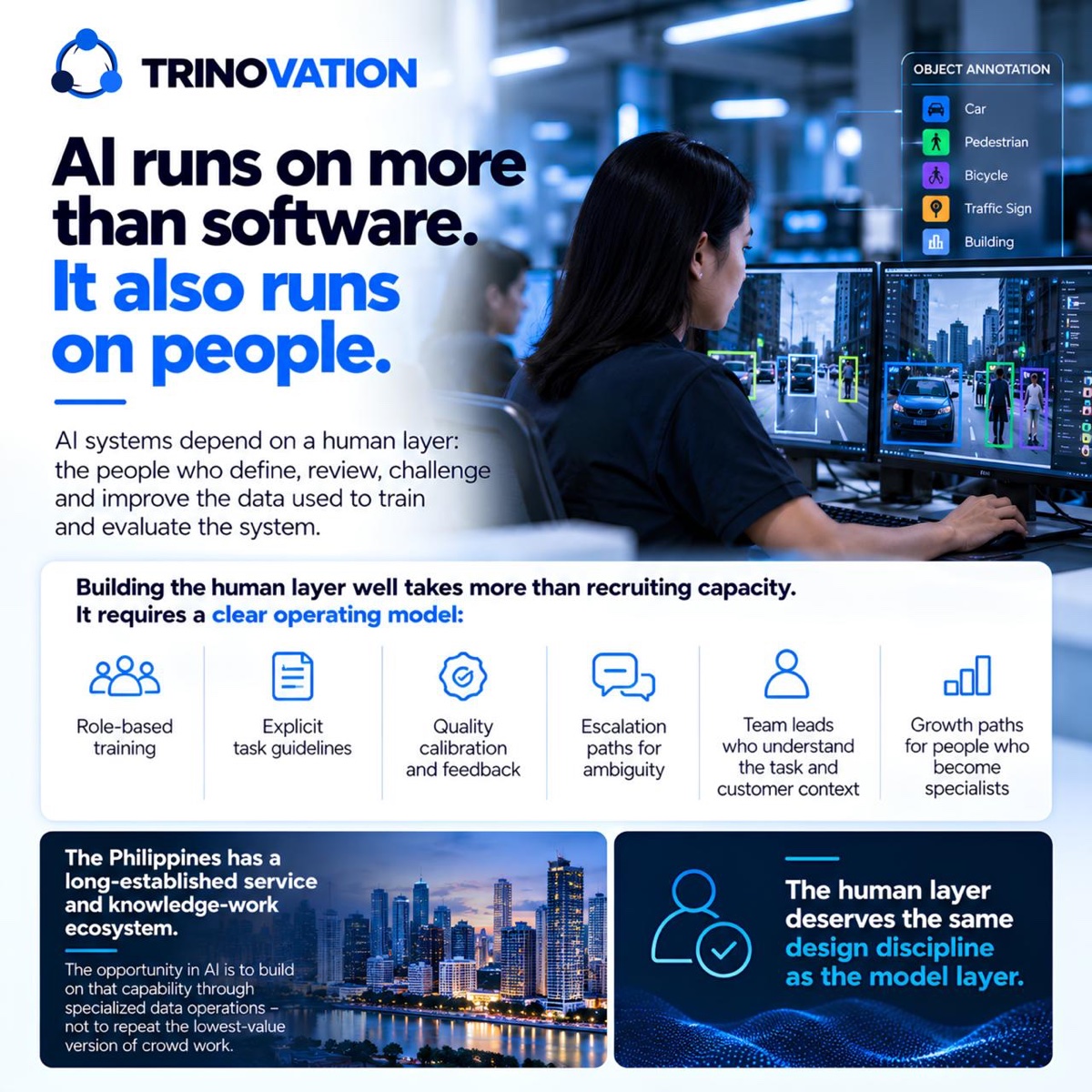
Building the human layer well takes more than recruiting capacity. It requires a clear operating model:
- Role-based training
- Explicit task guidelines
- Quality calibration and feedback
- Escalation paths for ambiguity
- Team leads who understand the task and customer context
- Growth paths for people who become specialists
Capacity is only the starting point
Recruiting a large group of people does not create a dependable data operation. The organization must define roles, train for the specific task, calibrate decisions and establish clear accountability for quality.
This becomes more important as the work moves beyond routine examples. Specialist cases require context, judgment and the ability to explain why a rule does or does not apply.
An operating model for specialist work
Role-based training should connect the reviewer to the intended product outcome, not only the interface. Guidelines should include positive examples, boundary cases and clear instructions for uncertainty. Calibration should be continuous, especially after taxonomy or policy changes.
Escalation paths matter because ambiguity cannot be eliminated through longer instructions alone. Reviewers need a safe and efficient way to raise questions, and the owners of the taxonomy need a defined process for answering them.
Why team leads matter
Team leads connect individual work to the larger quality system. They see repeated questions, monitor the effect of guideline updates and identify when a workflow is creating avoidable confusion. They also translate customer context into practical guidance for the team.
This role should not be reduced to queue management. A strong team lead is an early-warning system for data, policy and training problems.
The Philippines opportunity
The Philippines has an established ecosystem for service operations and knowledge work. The opportunity for AI data operations is to apply that experience to more specialized, quality-sensitive workflows.
That requires investment in domain learning, technical literacy, quality review and career development. It also requires a respectful story. The differentiator should not be framed only as lower cost. It should be framed as the ability to build disciplined teams that learn the customer's environment and improve with the work.
Career paths support reliability
People are more likely to build deep task knowledge when the operation recognizes progression: reviewer, senior reviewer, quality specialist, trainer or team lead. These paths create continuity and make specialist capability visible.
For buyers, continuity can mean faster calibration, clearer communication and less repeated learning. For the workforce, it creates a stronger connection between judgment, responsibility and professional growth.
Need a human layer built for specialist work?
Trinovation builds trained, calibrated review teams with team leads, escalation paths and structured feedback to your model team.
Get a Free 500-Frame Pilot →Design the human layer with intention
The human layer should have documented roles, evidence of training, measurable calibration, escalation behavior and a feedback loop to the customer or model team. It deserves the same design discipline applied to the model, data pipeline and product workflow.
Make quality visible to the buyer
A strong workforce story should be supported by operating evidence. Buyers should be able to understand the training path, calibration rhythm, quality-review layers, escalation categories and role of team leads. The goal is not to expose personal employee information. It is to make the system behind the workforce credible.
Reporting should connect workforce activity to learning. Show which guidance areas create questions, how quickly updates are adopted and how recurring error patterns are addressed. These indicators say more about maturity than a broad statement about talent quality.
Security and confidentiality should be integrated into role design. Access should reflect what each person needs to perform the task, and sensitive workflows should have clear handling rules. Responsible operations protect the customer and strengthen professional standards for the team.
Questions a U.S. buyer may ask
A U.S. buyer may want to know how time-zone coverage works, how leaders communicate with technical teams, how quickly a specialist group can be trained and what happens when demand changes. The content should anticipate those practical questions without turning the workforce story into a sales brochure.
The strongest answer is an operating model: named responsibilities, repeatable training, controlled quality, clear escalation and continuous improvement. Geography provides context. Dependable execution creates the value proposition.
How to keep the story credible
The public workforce story should describe practices the operation can substantiate. If role-based training, career paths or calibration processes are still being developed, state the direction without implying that every element is already mature. Credibility is more valuable than an expansive claim.
Use specific but non-confidential examples of operating design: how a question is escalated, how a team is calibrated or how a reviewer becomes a quality specialist. These details help U.S. buyers understand the capability without exposing employees, customers or sensitive performance information.
The human layer, designed with intention.
Trinovation deploys domain-trained review teams with QA workflows, escalation paths and structured feedback to your model team. First delivery in 2 weeks.
Get a Free 500-Frame Pilot → Book a 30-Min Call → Download the ChecklistSource and review note: This article is Trinovation editorial viewpoint. No labor-market statistics are asserted.