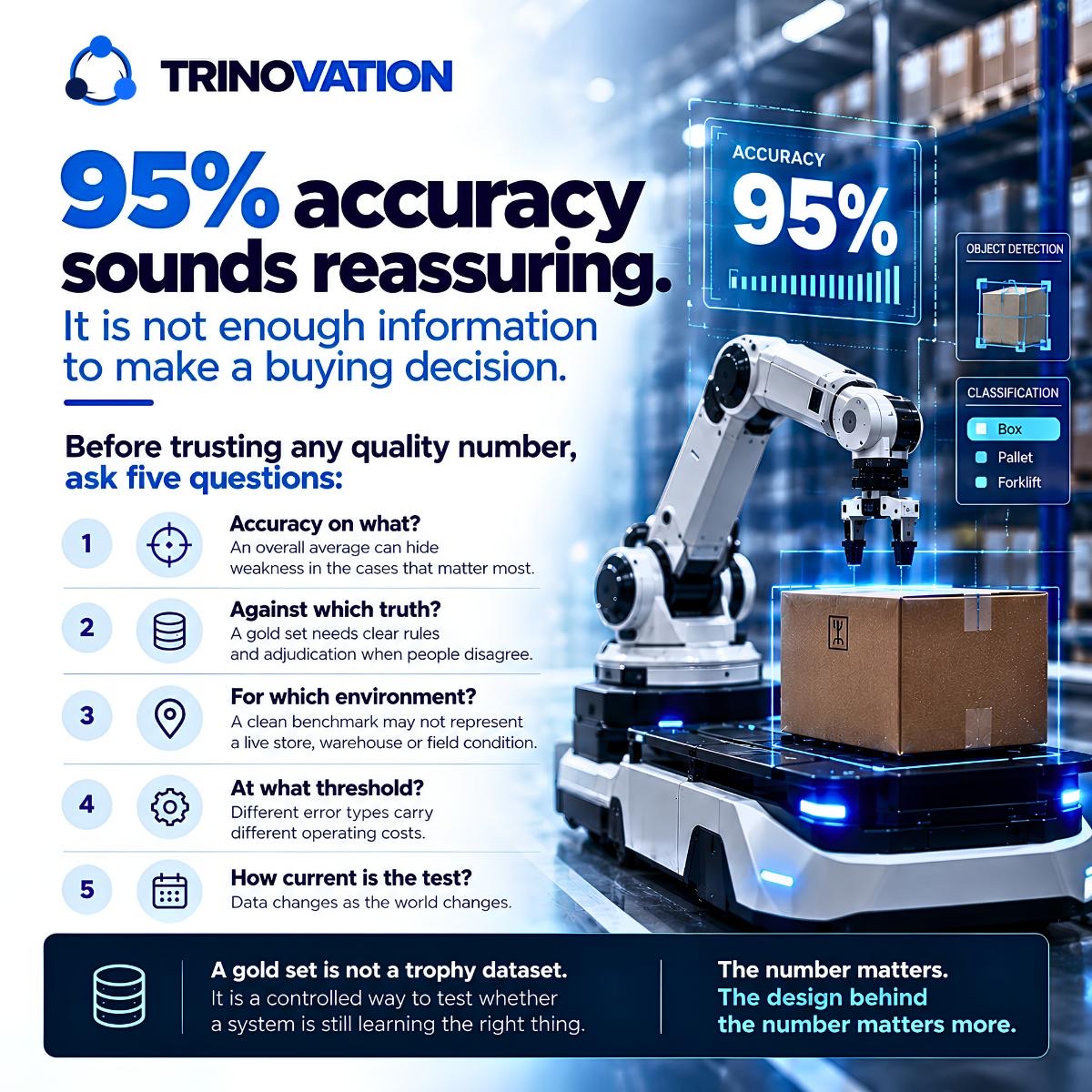
Accuracy figures create the appearance of simplicity. A single number makes it easy to compare models, teams or providers. It can also hide the information a buyer most needs to make a sound decision.
1Accuracy on what?
An overall average combines different categories, conditions and error types. A model can perform well on common examples while failing on the cases that carry the highest operating cost. The evaluation should segment results by the conditions that matter to the product.
For a retail system, that may include packaging changes, occlusion or specific store formats. For a warehouse system, it may include damaged items, low visibility or unusual layouts. The right segments come from the operation, not from an arbitrary reporting template.
2Against which truth?
A gold set is a controlled collection of examples with agreed answers. Those answers need definitions, qualified reviewers and an adjudication process. When knowledgeable people disagree, the disagreement should be resolved and documented rather than averaged away.
The provenance of the set matters as well. Buyers should know who created it, which taxonomy version was used and whether the examples represent the intended environment.
3For which environment?
A benchmark collected under clean conditions may not represent a live operation. Evaluation should include the lighting, layouts, devices, categories and exception patterns the system will actually encounter.
Representative does not mean every possible case. It means the test has enough of the normal work and the commercially important uncertainty to support the decision being made.
4At what threshold and cost?
Different errors have different consequences. A false positive that creates a low-cost review is not equivalent to a false negative that misses a safety, inventory or customer issue. A useful quality report makes those tradeoffs visible.
Thresholds should be connected to the workflow. The question is not only whether the model was correct, but whether its behavior produced the right level of confidence for the next operational action.
5How current is the test?
Gold sets age. Products, environments, sensors and policies change. A set that was representative six months ago may no longer test the conditions driving current errors.
A strong program versions the gold set, records changes and adds new cases through a controlled process. It protects comparability while allowing the evaluation to remain relevant.
A gold set is not a trophy dataset. It is a controlled way to test whether a system is still learning the right thing.
The design behind the number
A gold set should help a team make a decision: release, investigate, expand, retrain or change the workflow. If the evaluation cannot support that decision, greater numerical precision will not solve the problem.
Before trusting an accuracy claim, ask to see the definitions, segments, adjudication approach and update process behind it. The number matters. The evidence system that produced it matters more.
Want to see how we'd report on your data?
Send us a sample. We label 500 frames in 5 days and send back an accuracy report with the segments and definitions behind it — no contract, no call required.
Get a Free 500-Frame Pilot →Govern the gold set as a controlled asset
A gold set needs a named owner, access controls and a documented change process. If anyone can alter the answers or composition without review, comparisons over time lose meaning. If no one can update it, the set gradually becomes disconnected from production.
Changes should be versioned and explained. New examples may be added because the environment changed, a recurring edge case became important or the taxonomy gained a new category. Existing answers may change after adjudication. Each update should preserve enough history to understand why results moved.
Teams should also protect against contamination. If the same gold-set examples are repeatedly used for training or visible coaching, performance can improve on the test without improving general behavior. Maintain separate calibration, development and final-evaluation assets where the risk justifies it.
Use the gold set in partner evaluation
A buyer can use a representative evaluation set to compare operating approaches, but the purpose should not be to create a hidden exam. Give the provider the definitions and allow questions. The evaluation should test learning, consistency, escalation and improvement, not only first-pass familiarity.
Review disagreement patterns as closely as the final score. A provider that identifies weak guidance and documents uncertainty may be more valuable than one that achieves a similar number by making confident but unexplained choices. Quality includes the behavior around the answer.
What a defensible quality claim includes
A defensible claim states the population tested, the taxonomy and gold-set version, the important segments, the error types and the date of evaluation. It explains how disagreements were resolved and whether the examples reflect the intended environment. It also makes clear what the number does not prove.
This level of context does not weaken a quality claim. It makes the claim usable. Buyers can connect the evidence to their own risk and operating conditions, while providers avoid implying that one figure represents every category, environment and workflow.
Building the controlled data layer for physical AI.
Trinovation deploys domain-trained review teams with structured taxonomies, adjudication workflows and versioned gold sets. First delivery in 2 weeks.
Get a Free 500-Frame Pilot → Book a 30-Min Call → Download the ChecklistSource and review note: Our buyer-education framework. No external benchmark or universal accuracy threshold is asserted.