Physical AI is becoming a broader enterprise category. The systems may appear in stores, warehouses, facilities, factories, industrial supply chains or robotics platforms, but they share one requirement: they must interpret changing real-world conditions well enough to support an operating decision.
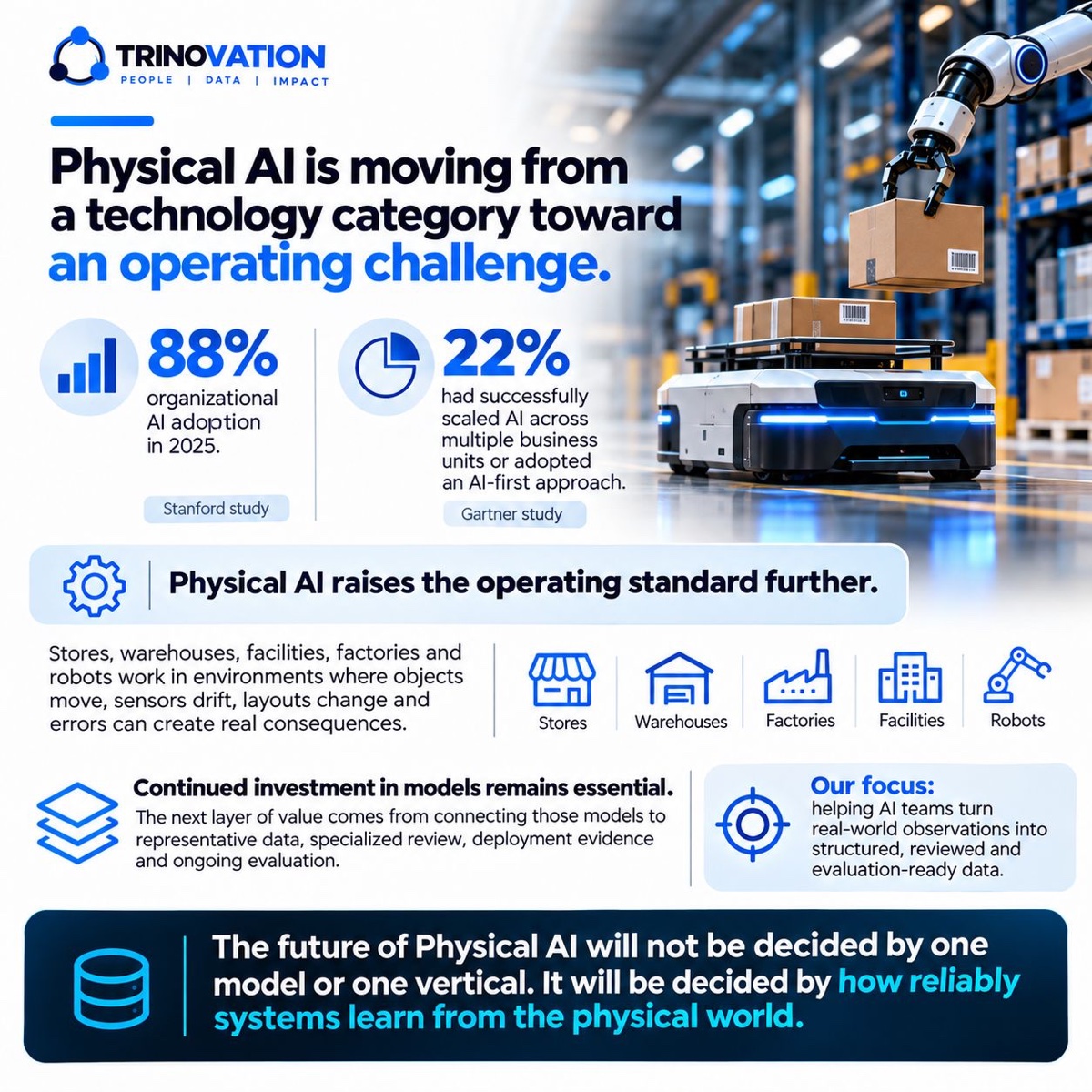
Physical AI at a glance:
- 88% organizational AI adoption in 2025 (Stanford AI Index).[1]
- 22% of surveyed organizations had successfully scaled AI across multiple business units or adopted an AI-first approach (Gartner).[2]
- 542,000 industrial robots installed in 2024, and 4.664 million in operational use (IFR).[3]
Stores, warehouses, facilities, factories and robots work in environments where objects move, sensors drift, layouts change and errors can create real consequences.
AI adoption is broad, but scale remains selective
The Stanford AI Index reports that organizational AI adoption reached 88% in 2025.[1] Gartner reported in September 2026 that only 22% of surveyed organizations had successfully scaled AI across multiple business units or adopted an AI-first approach. The Gartner survey included 1,303 respondents from organizations with at least $50 million in annual revenue.[2]
The studies use different samples and definitions, so the figures should not be compared as one continuous dataset. Together they show why access to AI and the ability to operate it at scale are different market signals.
Physical environments raise the production standard
A software workflow can often be repeated under controlled digital conditions. Physical systems encounter changing lighting, layouts, objects, equipment, sensors and human behavior.
Industrial adoption provides one indicator of how large that operating surface has become. The International Federation of Robotics reported 542,000 industrial robots installed in 2024 and 4.664 million in operational use.[3] Those numbers do not include the full Physical AI market, but they show the scale of systems already interacting with real environments.
The bottleneck moves toward evidence and evaluation
Model capability will continue to improve, and continued investment by leading technology companies remains important. The opportunity around those models is to make them dependable in a specific operating environment.
That requires representative data, clear taxonomies, specialist review, integration with operational systems and evaluation that continues as the environment changes. It also requires a feedback loop so new failures can become updated training or evaluation evidence.
Building AI that has to work in the physical world?
Trinovation turns real-world observations into structured, reviewed and evaluation-ready data for stores, warehouses, facilities and robotics.
Book a 30-Min Call →Different verticals, one controlled data layer
Retail systems may need to understand products, shelves and inventory. Warehouse systems may need pallets, movement and exceptions. Facilities and industrial systems may need machine states and sensor events. Robotics may need actions, trajectories and contact.
The definitions differ, but the operating discipline is reusable: define the decision, prepare representative evidence, review uncertainty, measure performance and return new conditions to the learning cycle.
Our role in Physical AI
Our role is in the data-preparation and evaluation layer: annotation, specialist review, quality assurance, gold sets and feedback from real operating conditions. We focus on this work within the wider Physical AI stack.
Our view is measured. Model innovation remains essential. Dependable Physical AI also needs a controlled way to learn from the real world.
Help your models learn from the physical world.
Domain-trained annotation teams, specialist review, gold sets and structured feedback to your model team.
Book a 30-Min Scoping Call → See the Free 500-Frame Pilot Download the ChecklistSource and review note: [1] Stanford HAI, AI Index Report, cited for 88% organizational AI adoption in 2025. [2] Gartner, survey published September 2026 (1,303 respondents from organizations with at least $50 million in annual revenue), cited for the 22% that had scaled AI across multiple business units or adopted an AI-first approach. [3] International Federation of Robotics (IFR), World Robotics, cited for 542,000 industrial robot installations in 2024 and 4.664 million in operational use. These sources measure different parts of the market and are not combined into a single market-size or scaling claim.