B2B buyers increasingly want proof before commitment. Forrester's 2026 predictions state that more than half of business buyers will use trials as a critical decision point, while emphasizing trust, validation and human expertise.[1] A pilot can meet that need, but only if it is designed to test the real operation rather than stage an easy demonstration.
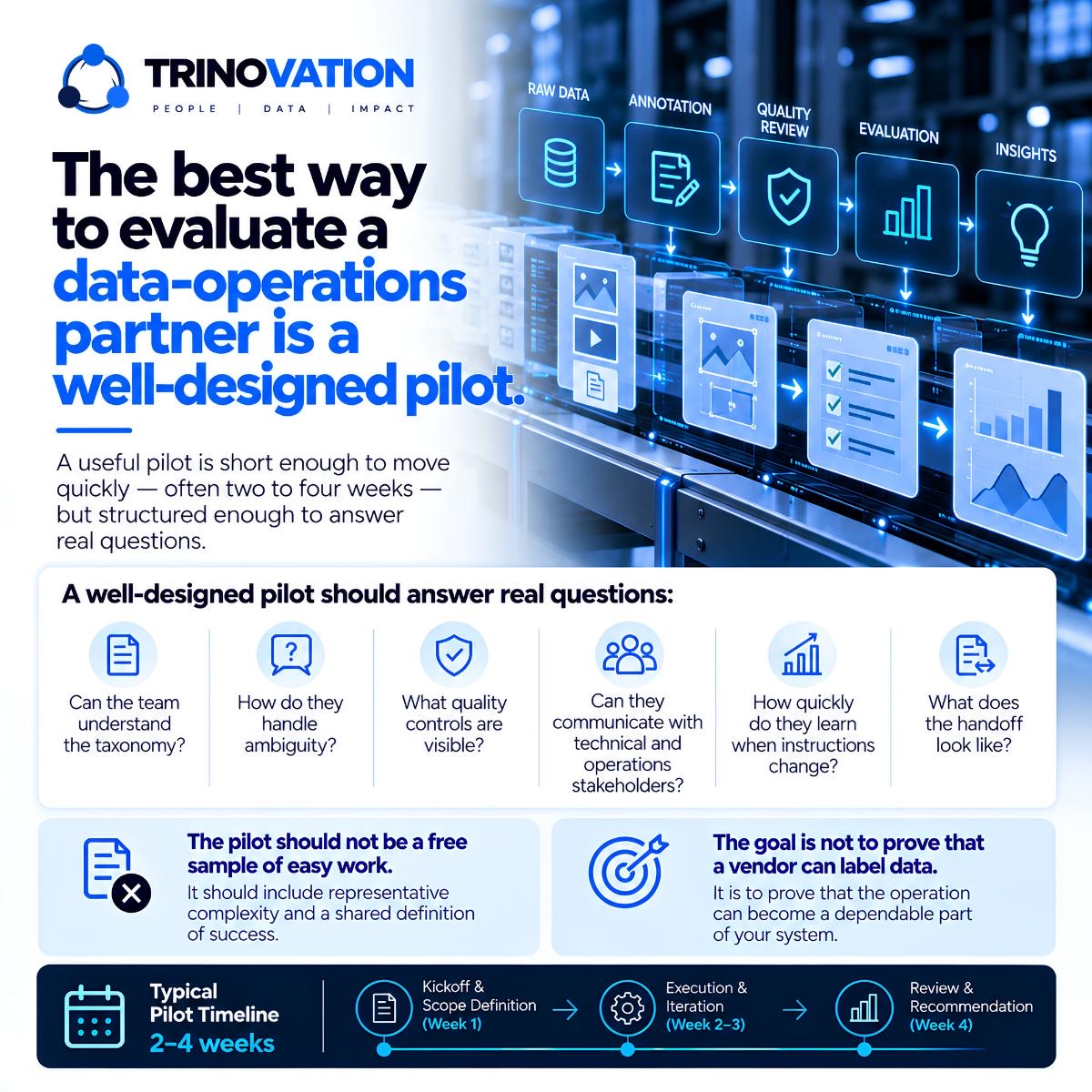
A well-designed pilot should answer real questions:
- Can the team understand the taxonomy?
- How do they handle ambiguity?
- What quality controls are visible?
- Can they communicate with technical and operations stakeholders?
- How quickly do they learn when instructions change?
- What does the handoff look like?
Typical pilot timeline (2–4 weeks): kickoff and scope definition (week 1), execution and iteration (weeks 2–3), review and recommendation (week 4).
Start with the decision the pilot must support
A pilot should answer a specific buying question. Can this team learn the taxonomy? Can it handle the expected ambiguity? Can it meet the communication and security requirements? Can the workflow expand without losing control?
If the decision is unclear, the pilot can produce activity without evidence. Define in advance what result would justify continuation, a larger capacity commitment, a redesigned workflow or a decision not to proceed.
Use representative work
A pilot built entirely from easy examples proves very little. The scope should include normal work and a meaningful sample of the uncertainty the production team will face. It does not need to include every extreme case, but it should represent the reasons the buyer needs an external operation.
The sample should also be bounded. A pilot is not a substitute for completing a production backlog at no cost. Its purpose is evaluation, shared learning and risk reduction.
Agree on the definition of quality
Before work begins, document the taxonomy, acceptance criteria, gold-set or adjudication approach and expected escalation behavior. If reviewers disagree, the pilot should show how the team resolves and records the disagreement.
Quality should be reported by the segments that matter. A single overall number may not reveal whether the team handled the most important cases well.
Test operating fit
The pilot should exercise communication, reporting, feedback turnaround and ownership. Include at least one controlled guidance change so the buyer can see how quickly the team learns and how updates are implemented.
Security and data-access boundaries must be confirmed before launch. A fast pilot is not an exception to responsible access control.
Evaluate the buying group, not one user
AI data operations usually affect technical, product, operations, procurement and executive stakeholders. Gartner's buyer research notes that B2B buying groups can span several functions and that group-relevant content supports consensus.[2] The pilot scorecard should therefore produce evidence multiple stakeholders can use.
Technical leaders may focus on error patterns and learning speed. Operations leaders may focus on consistency and communication. Commercial stakeholders may focus on scale, control and risk. One shared evidence package helps the group reach a defensible decision.
Finish with a scale decision
At the end, compare the evidence with the criteria agreed at the start. Identify what worked, what changed, which risks remain and what the next operating model would require.
A well-designed pilot does not guarantee a partnership. It creates a fair, fast and useful basis for deciding whether a partnership should exist.
Planning a vendor pilot?
We'll help you scope one around your real taxonomy and your hardest cases, with the decision criteria agreed up front.
Scope a Pilot With Us →A practical pilot scorecard
A useful scorecard can include six areas: taxonomy comprehension, first-pass and adjudicated quality, ambiguity handling, communication, learning after feedback and readiness to scale. Each area should have evidence, an owner and an agreed interpretation.
Avoid turning the scorecard into a long list of unweighted measures. Identify which two or three outcomes are required for the decision. A pilot can succeed on speed and still fail if it cannot handle ambiguity. It can perform well on quality and still fail if security or communication is unsuitable.
Include observations from both sides. The provider should document unclear definitions, missing examples and workflow risks. The buyer should document whether the team was responsive, transparent and able to improve. A partnership requires mutual operating fit.
Common pilot failure modes
Pilots fail when the scope contains only easy work, the buyer changes criteria after results arrive, feedback is delayed or no one has authority to answer questions. They also fail when the provider treats the exercise as a performance showcase and hides uncertainty instead of demonstrating how it manages it.
Prevent these problems with a short written charter: purpose, scope, data access, definitions, owners, communication rhythm, change handling and decision criteria. The charter does not need to be complicated. It needs to make the evaluation fair and useful.
The final pilot conversation
The closing meeting should not begin with a sales proposal. It should begin with the evidence: what the pilot tested, what the team learned, where definitions changed, which risks remain and whether the original decision criteria were met. Both sides should be able to challenge the interpretation.
Only then should the group discuss scale. The next step may be a production phase, a narrower specialist workstream, a second controlled test or no partnership. A pilot creates trust when it produces an honest decision, not when it is designed only to produce a sale.
Test the operation, not the demo.
Bring your taxonomy, your edge cases and your decision criteria. We'll design the pilot around them and report the evidence segment by segment.
Book a 30-Min Scoping Call → See the Free 500-Frame Pilot Download the ChecklistSource and review note: [1] Forrester, 2026 B2B predictions, cited for the expectation that more than half of business buyers will use trials as a critical decision point. [2] Gartner, B2B buyer research, cited for buying groups spanning several functions and the role of group-relevant content in reaching consensus. The 2–4 week duration is Trinovation's recommended working range, not an external benchmark.