Warehouse AI is often presented through its most visible systems: cameras, drones, robots, routing tools and automated inventory platforms. Behind those systems is a harder question: how does the operation establish what actually happened?
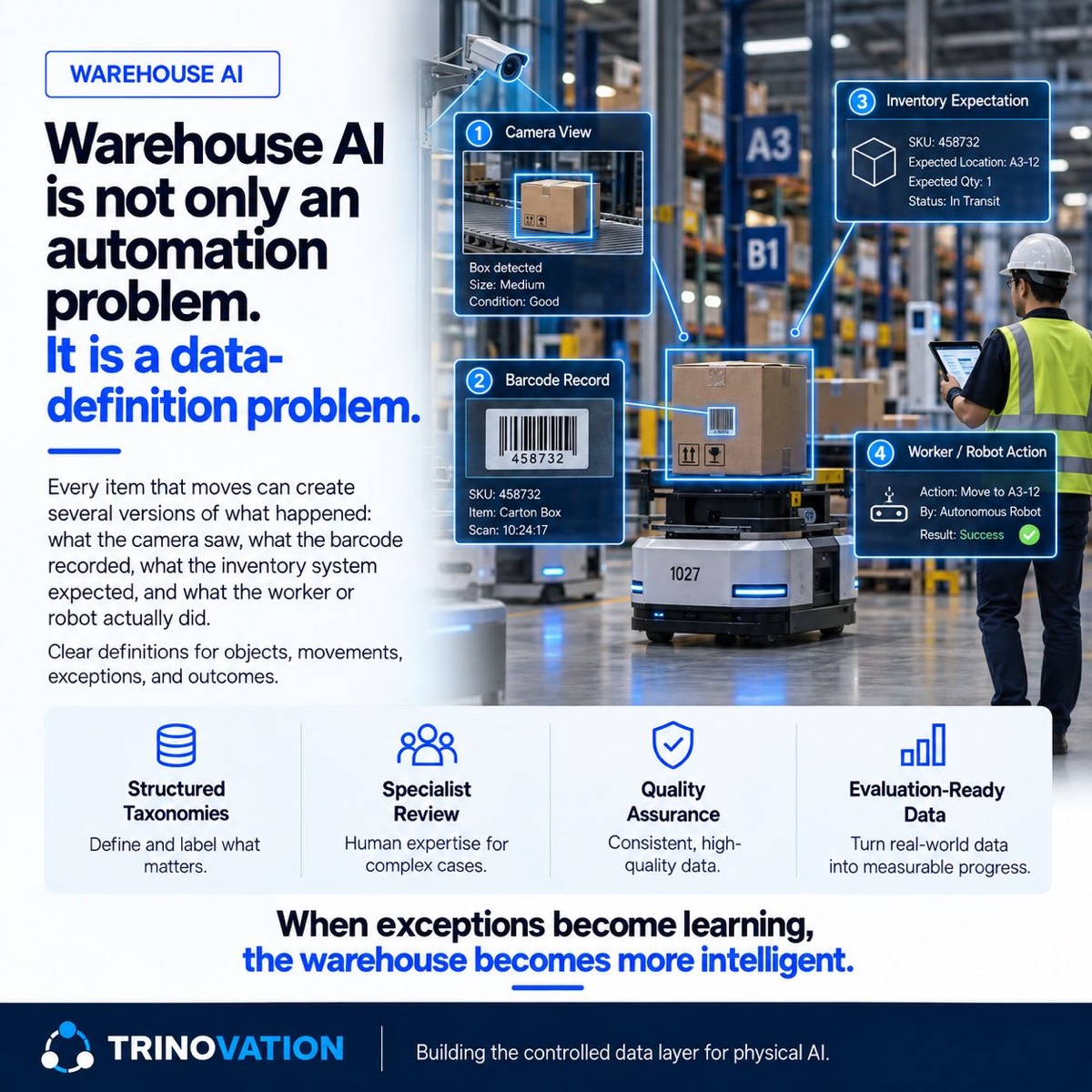
One movement can produce conflicting records
A camera may show a pallet entering a zone. A barcode scan may identify the item. A warehouse management system may expect a different location. A worker or robot may move the item again before the systems synchronize.
| Source | What it records |
|---|---|
| Camera view | What was visually observed — object, size, apparent condition |
| Barcode scan | Item identity and the moment it was read |
| Inventory system | What was expected — SKU, location, quantity, status |
| Worker or robot action | What was actually done, and whether it succeeded |
Each source contains useful evidence, but none automatically becomes ground truth. The team still needs definitions for the object, the movement, the exception and the outcome.
That becomes especially important when packaging is damaged, a barcode is partly visible, a pallet is stacked differently than expected or an inventory record conflicts with the physical scene.
Public examples show the range of data involved
Walmart describes predictive warehouse and transportation systems that coordinate orders, flag anomalies and optimize outbound flow. It also describes smart cameras and real-time performance tracking within warehouse control systems.[1]
Amazon's Vulcan provides another company-reported example. Amazon says the robot combines camera vision with force-feedback sensors, can pick and stow approximately 75% of the item types in its fulfillment centers and can request human help when it cannot handle an item.[2]
These examples should not be treated as independent market benchmarks. They are useful because they show how warehouse AI combines images, sensors, inventory records, actions and human escalation.
Exceptions should improve the system
A difficult case creates limited value if the answer disappears after a queue is cleared. The resolution should be reusable: an updated guideline, a gold-set example, new training data, an evaluation case or a product requirement.
This requires a defined operating loop:
- Capture the exception.
- Review the available evidence.
- Record uncertainty.
- Decide whether the taxonomy or model needs to change.
- Test whether the updated system performs better on that condition.
Turning warehouse exceptions into training data?
Send us a sample. We label 500 frames in 5 days and send back an accuracy report — no contract, no call required.
Get a Free 500-Frame Pilot →People make the evidence dependable
Consistent warehouse data depends on reviewers who understand objects, movements and exceptions, supported by clear annotation guidelines, quality checks and evaluation datasets.
This is the operating work we support: helping teams resolve conflicting evidence and turn it into structured, consistent data that model and product teams can use.
Building the controlled data layer for physical AI.
Trinovation deploys domain-trained review teams with structured taxonomies, QA workflows and evaluation-ready datasets. First delivery in 2 weeks.
Get a Free 500-Frame Pilot → Book a 30-Min Call → Download the ChecklistSource and review note: [1] Walmart and [2] Amazon are company-reported examples. They do not imply a relationship with us or describe the entire warehouse-AI market. All operating implications are Trinovation editorial analysis.