Imagine you’ve gone to buy your usual coffee. The store’s website says it’s available, but the shelf is empty.
You ask someone for help. Perhaps there’s more in the stockroom. Perhaps it’s been moved. Perhaps the stock record is wrong.
Now imagine an AI system has already spotted the gap.
Would you send someone to refill the shelf, check the stockroom or first question the alert?
The useful next step depends on what the system actually knows. That is where we begin this series on the Retail AI Stack.
Following the result into the store
AI can recognize things, make predictions and generate answers. But when we ask whether it makes everyday life better, we need to follow the result a little further.
Did the right person get the information? Was it clear enough to act on? Did you find your coffee?
We’re exploring those connections through the Retail AI Stack: the pieces that help a system observe a store, understand what’s happening and support a response. Retail is our starting point within the broader world of Physical AI, which also includes robotics, warehouses and other settings where AI interacts with the physical world. In these articles, we’ll stay close to experiences most of us recognize.
With so much enthusiasm and concern surrounding AI, we find that a familiar situation helps make the conversation more concrete. An empty shelf gives us something to examine together.
A camera might capture the gap, while an inventory record says there are still twelve bags of coffee in the store. Both observations could be correct. The challenge is understanding what they mean together and what someone should do with that information.
Why this matters as retailers adopt AI
The discussion is moving into day-to-day retail work. In NRF’s Retail AI Trends 2025 survey, 57% of respondents said they had implemented or were implementing AI tools to support associates.[1] The survey collected 56 responses, mostly from large retailers, so it should not be read as an adoption rate for the entire industry. It does show why the connections behind the tool deserve attention. Getting AI into a workflow brings questions about data, reliability and responsibility with it.
Our reading is that the useful next conversation is about how these systems fit into work, not simply how many companies announce them. A shelf alert lets us examine that question without assuming every retailer needs the same technology.
The six parts behind a useful shelf alert
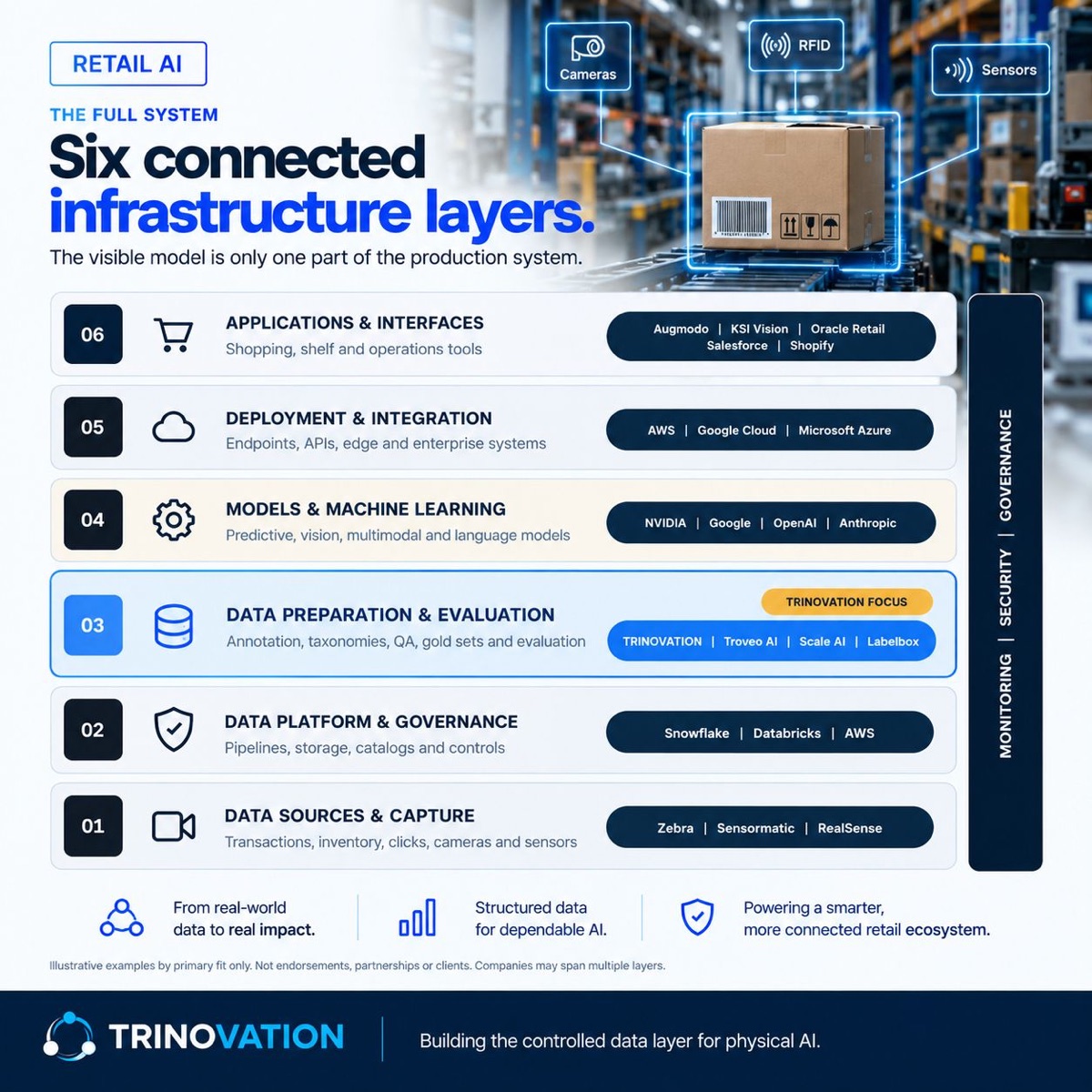
Our framework has six connected layers:
- Data sources and capture provide observations.
- Data platforms and governance keep records usable and controlled.
- Data preparation and evaluation define examples and test answers.
- Models interpret the information.
- Deployment and integration connect those results with working systems.
- Applications and interfaces help people understand and act on them.
These are useful categories for discussion, not a universal industry standard or a strict sequence. A company may work across several layers, and information often travels back through the system. Monitoring, security and governance matter throughout. The stack helps us ask which responsibility is missing when an impressive result does not lead to a useful outcome.
Our work on the data-preparation side has shaped how we think about these questions. In one of our spatial-AI projects, our annotation team trained on a client’s retail-shelf labeling definitions, with quality checkpoints aligned to the model team’s training schedule.
It sounds like a small part of the story. Yet deciding whether something is empty, hidden or misplaced influences what the model learns. Those distinctions also affect what counts as a correct result.
We take that as a reason to look closely at the handoffs throughout a system, including the ones that rarely appear in a demonstration.
For another window into the industry, consider Augmodo’s Smartbadge, which captures shelf observations as employees move through a store.[2] It makes the connection between a physical aisle and digital information tangible. From there, we can ask how that information reaches people and helps them respond.
Across this series, we’ll use examples like these to explore the Retail AI Stack, sharing what we know from our work and how we interpret the choices around it. You won’t need a technical background to follow along.
The thought we want to leave you with is simple: recognizing a problem and helping solve it are different achievements.
A practical shelf challenge
Stay with our imagined store. The AI reports an empty coffee shelf, while the inventory record shows twelve bags. You want to understand the apparent mismatch before deciding what should happen next. Which check would most directly help?
- A. Check how accurately the model recognizes coffee packaging.
- B. Check whether the stock record describes this shelf or the whole store, and when it was updated.
- C. Check whether the alert reaches the colleague responsible for the aisle.
How we would approach it
We’d start with B. The two records may describe different places or moments. Twelve bags in the stockroom and an empty shelf can both be correct. That check would not prove the model is right or that the coffee is available now. A helps investigate recognition errors; C helps turn a finding into action. Each matters, but they resolve different questions.
If you build or work with AI, where have two apparently conflicting signals turned out to describe different parts of the same situation? We’d be interested in what helped you make sense of them.
Sources & Review Note
- National Retail Federation, Retail AI Trends 2025. Survey of 56 AI leaders at U.S.-based retailers.
- Augmodo, company product description of Smartbadge.
The NRF sample is small and skewed toward large retailers; the 57% figure is not an industry-wide adoption rate. The Smartbadge description is company-reported. The six-layer framework is Trinovation’s editorial model, not an industry standard. The coffee scenario is illustrative. Company names in the infographic are illustrative examples by primary fit only, not endorsements, partnerships or client relationships; companies may span multiple layers.
Defining what “empty,” “hidden” and “misplaced” mean for your model?
Trinovation runs the annotated-data operations behind production computer vision and spatial AI, from labeling definitions to quality checkpoints and evaluation evidence.
Book a 20-Min Call → Start a Free 500-Frame Pilot