Retail AI is often introduced through its most visible component: a shopping assistant, recommendation engine, camera, robot or forecasting model. Those technologies may be what customers and employees see, but none of them operates alone.
There is no single, universally accepted retail AI stack. Cloud providers, retailers and technology vendors organize their systems differently. Still, their architectures generally cover the same responsibilities. The six-layer framework below is our practical way of making those responsibilities visible.
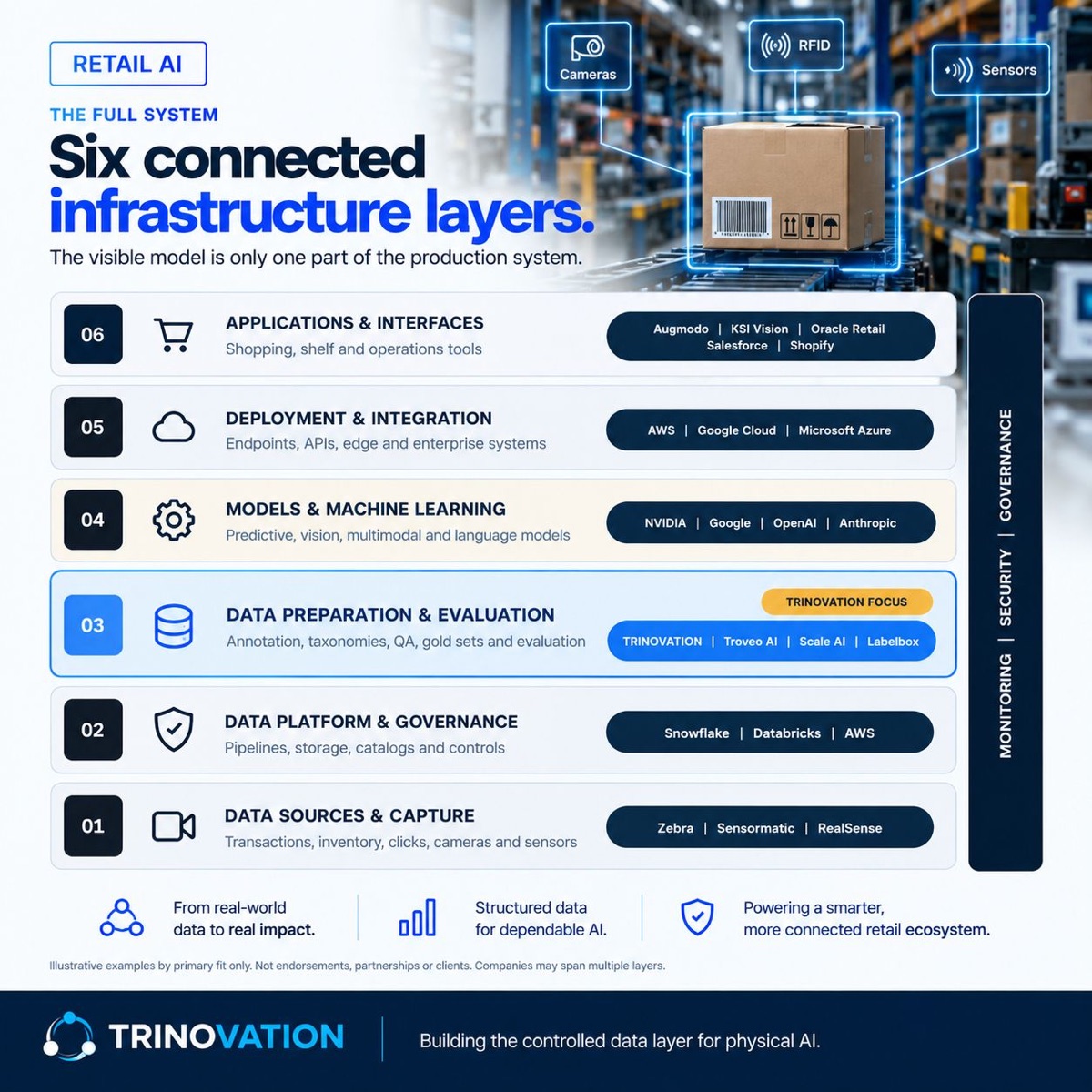
1Data sources and capture
Every retail AI system begins with observations of the business. Depending on the use case, those observations may come from point-of-sale transactions, product catalogs, inventory and order systems, loyalty activity, web and app behavior, cameras, RFID readers, environmental sensors or warehouse equipment.
The source determines what the system can observe. A recommendation system needs interaction and product data. Shelf intelligence needs visual evidence and product definitions. A warehouse system may also need location, movement, force or equipment data. If a relevant condition is never captured, the model cannot learn or evaluate it directly.
2Data platform and governance
Captured data must be moved, stored, organized and governed before it can reliably support AI. This layer includes streaming and batch pipelines, data lakes and warehouses, catalogs, feature stores, access controls, provenance and freshness rules.
Google Cloud's official product-recommendation architecture, for example, moves clickstream data through processing services into BigQuery, where product information, behavioral insights and embeddings support a recommendation service.[1] The specific products are vendor choices; the underlying responsibilities — ingestion, transformation, storage and retrieval — are broader architectural needs.
Useful questions at this layer include:
- Where did the data originate, and do we have permission to use it?
- How current is it, and which product, customer, store or event does it represent?
- Which transformations were applied before a model or evaluator received it?
3Data preparation and evaluation
Stored data is not automatically usable ground truth. Teams still need to define what matters, represent it consistently and test whether the model behaves as expected. This layer includes annotation, taxonomies, task guidelines, specialist review, quality assurance, disagreement handling, gold sets and evaluation datasets.
Consider shelf availability. A camera image alone does not define whether a product is in stock, misplaced, partially hidden, blocked by glare or represented by packaging that recently changed. Those distinctions must be defined, labeled and reviewed consistently before the data can support dependable training or evaluation.
This is the layer we focus on. Model capability gets most of the attention; the data feeding and evaluating it is where reliability is actually won or lost.
4Models and machine learning
The model layer contains the technologies that identify patterns or generate outputs. Retail systems may use predictive models for demand and pricing, recommendation models, computer vision for products and spaces, multimodal models that combine image and text, and language models or agents for interaction and coordination.
Model capability is essential, and industry leaders continue to advance it. The data preparation and evaluation layer complements that investment by giving teams clearer evidence about what a model learned, where it fails and whether a change improved real performance.
5Deployment and integration
A trained or hosted model creates value only when it can be used within the operating environment. This layer includes endpoints, APIs, containers, orchestration, edge deployments and connections to systems such as ERP, inventory, order management and warehouse management platforms.
AWS's official retail edge guidance shows this connection clearly: in-store sensors and cameras feed local AI capabilities; models are prepared and deployed; events move through an event bus; applications interact with enterprise services; and feedback can return for later training.[2] The products are AWS-specific, but the need to connect sensing, models, systems and feedback is not.
A technically correct model output can still fail if it arrives too late, reaches the wrong workflow, or cannot be acted on by the store, warehouse or customer application.
6Applications and interfaces
The application layer is where customers and employees experience the system. Customer-facing examples include conversational shopping, recommendations, search, virtual try-on, replenishment and service. Operations-facing examples include shelf intelligence, inventory tools, forecasting, warehouse optimization, loss prevention and associate support.
Microsoft's retail AI materials similarly organize capabilities around unified data, customer experiences, employee tools and operations.[3] That's useful evidence that retail AI spans front-end and back-end work, though it should be treated as vendor material rather than neutral market research.
Turning shelf, warehouse or transaction data into evaluation-ready datasets?
Send us a sample. We label 500 frames in 5 days and send back an accuracy report — no contract, no call required.
Get a Free 500-Frame Pilot →Monitoring and feedback connect the stack
The architecture is not a one-way line from data to application. Live use creates new evidence. Lighting changes, products change, customer behavior shifts, integrations fail, and the model encounters combinations that were rare or absent during development.
NIST's 2026 report on monitoring deployed AI systems highlights data drift, feedback loops and the difficulty of connecting predeployment evaluation with postdeployment results.[4] The practical implication is that evaluation must continue after launch.
A useful production feedback loop asks:
- What changed in the environment or data?
- Which outputs were incorrect, uncertain or operationally unhelpful?
- Which cases require specialist review?
- Do the taxonomy, instructions or quality rules need to change?
- Should the case enter a training set, an evaluation set, or both?
- Did the next version improve under the same conditions?
Reliable learning needs a maintained data operation
Keeping this feedback loop useful takes people who can interpret ambiguous examples, maintain definitions and prepare reliable evaluation data. We support that work through annotation, quality assurance and specialist review, helping teams turn production evidence into reusable learning — the same discipline behind how we think about sensor data and warehouse exceptions more broadly.
That's one layer in a larger system, but it's a consequential one. A model cannot reliably learn or demonstrate improvement if the examples, definitions and evaluation evidence around it are unclear.
Questions for retail AI buyers
- Which sources provide the operating evidence for this use case?
- How is the data stored, governed and kept current?
- Who defines and annotates ground truth, and how are disagreements resolved?
- Which evaluation conditions represent the live environment?
- Which enterprise systems must receive or act on the output?
- How will the system respond when data, products or operating conditions change?
- How will production feedback improve the next version?
The most important question is not simply which model a retailer selects. It's whether the complete infrastructure can keep that model reliable as the retail environment changes.
Building the controlled data layer for physical AI.
Trinovation deploys domain-trained review teams with structured taxonomies, QA workflows and evaluation-ready datasets. First delivery in 2 weeks, no minimum commitment.
Get a Free 500-Frame Pilot → Book a 30-Min Call → Download the ChecklistSource and review note: [1] Google Cloud, official product-recommendation reference architecture. [2] AWS, official retail edge AI guidance. [3] Microsoft, retail AI product materials — vendor material, not neutral market research. [4] NIST, 2026 report on monitoring deployed AI systems. Company and product names in the infographic are illustrative examples by primary fit only, not endorsements, partnerships or client relationships; companies may span multiple layers. All operating implications are Trinovation editorial analysis.