Retail AI is entering a more demanding phase. The question is no longer only whether a retailer has launched an experiment. It is whether AI can connect to live inventory, store, warehouse, customer and associate workflows with enough reliability to influence daily decisions. Public market research and company examples suggest that budgets and use cases are moving in that direction, while the requirements for data quality, evaluation and governance are becoming more visible.
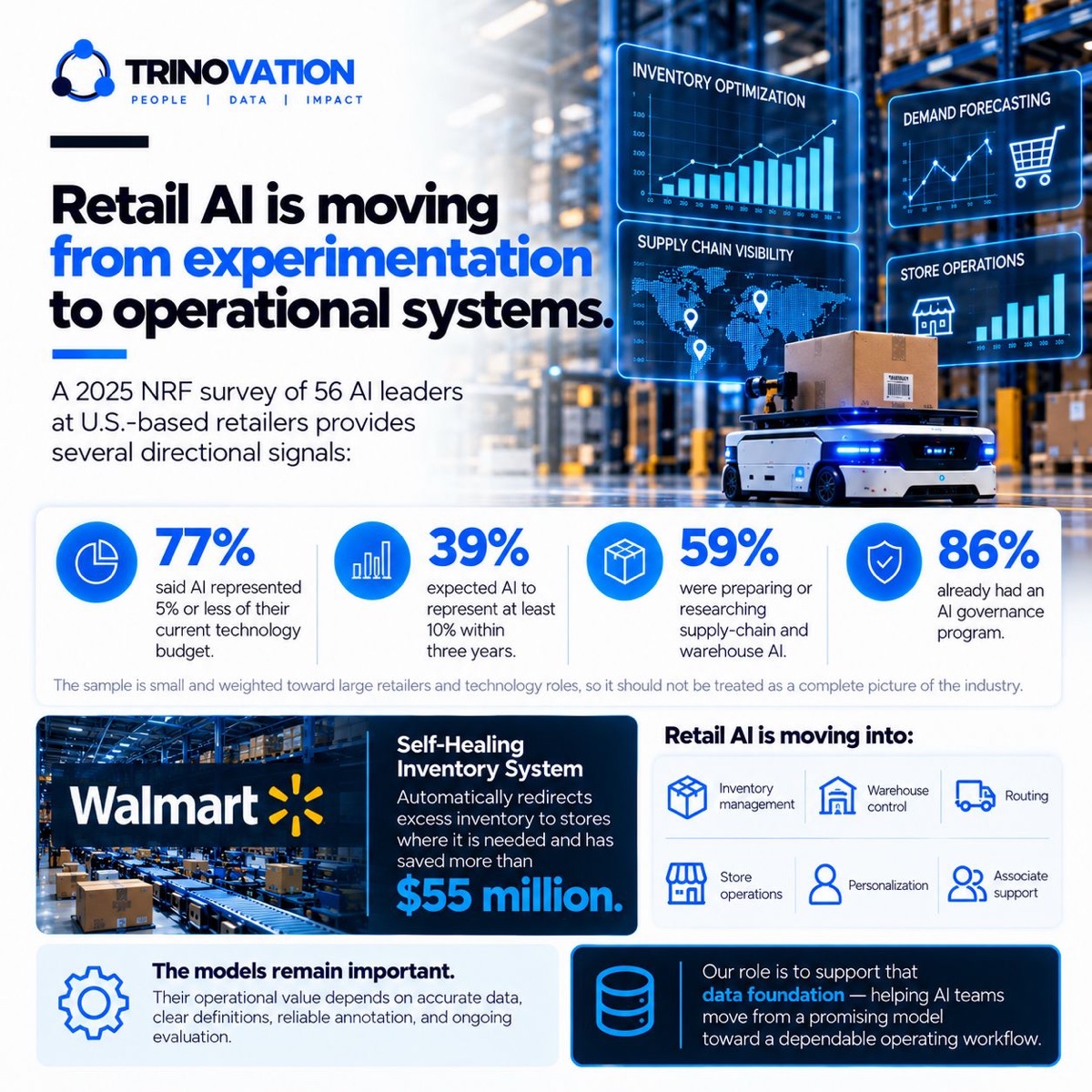
Retail AI at a glance (NRF, 2025):[1]
- 77% said AI represented 5% or less of their current technology budget.
- 39% expected AI to represent at least 10% within three years.
- 59% were preparing or researching supply-chain and warehouse AI.
- 86% already had an AI governance program.
Retail AI is moving into inventory management, warehouse control, routing, store operations, personalization and associate support.
Signal 1: budgets are expected to increase
In a 2025 survey of 56 AI leaders at U.S.-based retailers, NRF found that 77% said AI represented 5% or less of the current technology budget. Looking three years ahead, only 41% expected AI to remain at 5% or less, while 39% expected AI to account for at least 10%.[1]
The sample is small and directional. Seventy-nine percent of respondents worked in technology roles, and 70% represented retailers with more than $1 billion in revenue. The figures should therefore be presented as a view into larger U.S. retailers, not a forecast for the entire industry.
Signal 2: use cases are becoming operational
The same NRF survey found that 66% of respondents had implemented or were implementing AI for customer personalization, 57% for associate-support tools and 59% were preparing or researching supply-chain and warehouse use cases.[1] These are not isolated content-generation tasks. They connect AI to customer decisions, store work and the movement of physical goods.
McKinsey's 2026 consumer research also points toward AI taking a larger role in basket building, automated replenishment and post-purchase support. In its survey of more than 3,000 U.S. consumers, 37% ranked in-stock reliability among their top three reasons for choosing a retailer.[3] That connection matters: an AI shopping interface is only as useful as the product, pricing and availability data behind it.
Signal 3: governance is becoming operational
NRF reports that 86% of respondents already had an AI governance program and 93% planned to develop or continue developing governance during the following 12 months.[1] Governance is no longer only a legal review at the end of a project. It increasingly affects which data can be used, how a system is evaluated, when a person must review an output and how performance is monitored.
The same survey identified cost and model accuracy or reliability as the leading strategic concerns, each selected by 57% of respondents. That combination reinforces the need for targeted evaluation: retailers need to know not simply whether a system works on average, but whether it works well enough in the categories and conditions where errors create cost or customer impact.
A production example: Walmart's inventory system
Walmart says its global supply chain uses AI and automation to predict demand, reroute inventory and reduce waste. The company reports that its Self-Healing Inventory system detects stock imbalances, redirects products to stores where they are needed and has saved more than $55 million.[2]
This is a company-reported result rather than independent market evidence, but it illustrates the operating pattern. Value appears when real-time signals connect to a defined decision and an action inside the retail workflow. The model is one component of a broader system that includes inventory data, rules, integrations and performance monitoring.
Building retail AI that has to work in stores and warehouses?
Trinovation builds and maintains the annotated data and evaluation sets behind retail and physical AI, with quality controls you can see.
Book a 30-Min Call →What the market direction means for data operations
As use cases move closer to store and supply-chain decisions, the data requirement becomes more specific. Teams need current product and location data, clear taxonomies, representative examples, controlled annotation and evaluation sets that expose performance across important conditions.
The operation must also handle change. New products, packaging, promotions, layouts, devices and customer behavior can alter what a model sees. Evaluation cannot be a one-time approval. It needs a feedback process that identifies new failure patterns, routes uncertain cases and updates the data used for training or testing.
How we support the data foundation
We do not need to argue that retailers or technology leaders are investing too heavily in models. Model capability is the foundation of these systems and will continue to advance. Our view is that production value depends on the data and evaluation operation surrounding the model.
We can support AI teams by producing structured annotated data, applying quality controls and helping maintain evaluation-ready datasets. Our focus stays specific as retail AI moves from experimentation into operational workflows.
Questions for retail AI leaders
Before expanding a use case, ask whether the data represents the locations, categories and conditions where the system will operate. Define which errors matter most, how uncertain cases are escalated and how new evidence will change the training or evaluation set.
The market is moving toward more capable models and more connected retail systems. The organizations that scale successfully will need both. The practical differentiator will be whether the data operation can keep the system reliable as the business and physical environment change.
Models move fast. Keep the data foundation reliable.
Domain-trained annotation teams, evaluation-ready datasets and structured feedback to your model team.
Book a 30-Min Scoping Call → See the Free 500-Frame Pilot Download the ChecklistSource and review note: [1] National Retail Federation (NRF), 2025 survey of 56 AI leaders at U.S.-based retailers; directional, weighted toward large retailers (70% with more than $1 billion in revenue) and technology roles (79%). [2] Walmart, company-reported results for its Self-Healing Inventory system. [3] McKinsey & Company, 2026 U.S. consumer research (more than 3,000 respondents). No internal observation from our team is presented as evidence.